Showing posts with label support group. Show all posts

Friday, 6 February 2015

Light, air, space, time, breath

I haven't blogged on here for ages. I've been mostly quite well, that's why! So there is light at the end of the tunnel for anyone feeling rotten with hypothyroidism. I've got various projects on the go these days so very little time for thyroid stuff but I still intend to post on here from time to time and in particular I want to get closer to the hypothyroid care strategy project which BTF are undertaking and where I see lots of opportunities to make things better for thyroid patients. I feel I've learned a lot on my journey and believe those lessons can be put to some use to help others - as and when I have time around the edges of the rest of my life.

There was a point when my work with the London Group and handling telephone support calls for BTF was taking up a huge amount of my life. My husband was alternately proud of what I was doing and horrified that I was doing so much and not getting paid for it! As I slowly got back to a degree of reasonable  health it was a bit like having the structure of a job and I really appreciated having the responsibility for something that felt important and where I felt I could be of some use. But it got to the stage where it was taking up more hours than I could justify so I had to take a big step back.

I am so delighted and thankful that the group is ongoing and so thankful to the Team for continuing with it. And much as I very much enjoyed talking to other thyroid patients on the phone, as a support contact for the charity, I'm very relieved not to be constantly having those kinds of conversations any more as they are emotionally quite draining, especially when I was effectively on call all the time and listed as the main contact for the whole of London, the most densely populated part of the country!

I'm very happy to be able to flag up to you that the group have now announced a whole series of dates for meetings in London this year, which is brilliant. You can get details on the link at the top right of the side navigation, or here. Precious space and time for thyroid patients to come together, support each other, learn about our conditions and what we can do to help ourselves-and just have a nice time with good people who have some insight into what we're all going through.

I can't make the Feb meeting but will be at the one in March. I hope to see some of you there.

Signing off for now with gratitude to you for reading and being with me on my thyroid journey. It has meant the world to be able to connect with so many other people going through similar experiences and I intend to stay connected and continue to share both my own experiences and anything else I think might be of use to others with hypothyroidism. Because it's a tough old game and we all need all the support and reliable info we can get - right!

One thing I will do this year is write up the notes from the various talks we've had that I haven't had a chance to report back on fully yet.  If there's one in particular you'd like me to do first let  me know.

Sending smiles to you and yours.

And a nice beach photo taken this chilly February morning here in Broadstairs. I won't say anything about how cold it was but doesn't it look pretty!

Viking  Bay, just 1 hour 22 mins from St Pancras on HS1 


Tuesday, 13 August 2013

Our walk, in pictures, with a folkie flavour...


This year's BTF London Group Big Summer Walk for British Thyroid Foundation coincided with Broadstairs Folk Week.... 

The hooden horse, emblem of Broadstairs Folk Week 

Since I moved to Broadstairs in 2011 the group have initiated a tradition that each summer a few members come to see me and we do a walk to raise money for the charity, from Broadstairs to Ramsgate and back, along with anyone else who wants to join us. Let me know if you'd like to take part next year.

It's a beautiful stroll. Not too taxing and mostly flat, we feel it's  important to have an event that people who may not be feeling very well can still take part in. In total the distance is about 8km and the route allows for a pleasant break in Ramsgate Royal Marina, where we treated ourselves to fish and chips, coffee and ice cream, to fuel our walk back!

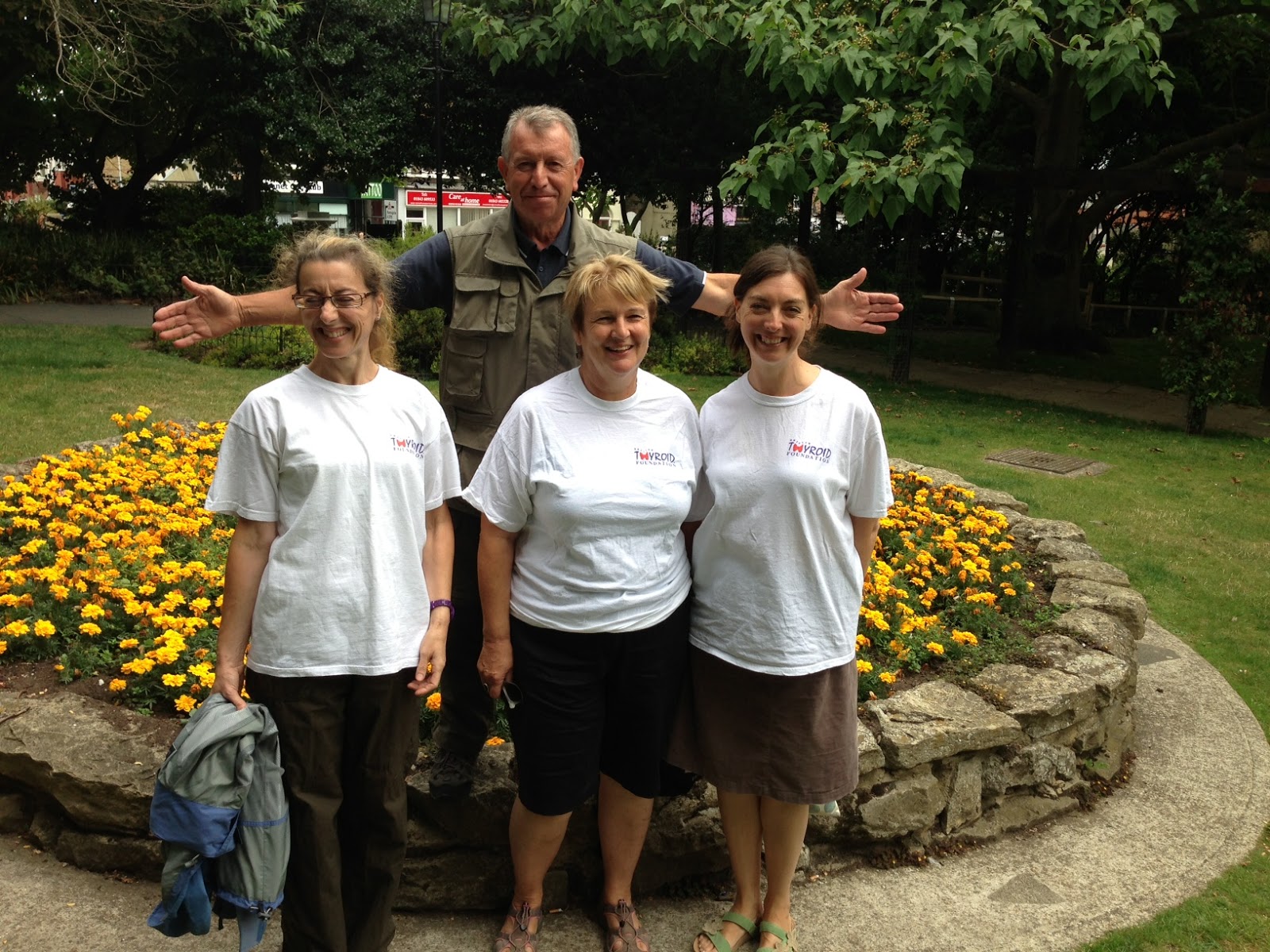
With huge thanks to Anna, Linda and Giovanni who took part with me. Here is our story in pictures:

setting of from Pierremont Park, l-r: Anna, Giovanni, Linda, Lorraine

on the promenade in Broadstairs 

Broadstairs folk week performers

above Viking Bay, the main beach in Broadstairs

Linda and Giovanni with Viking Bay in the background

arriving at Ramsgate Royal Marina


Linda and Anna with Ramsgate Royal Marina in the background

Linda with Ramsgate main beach in the background

Anna enjoying a coffee on the Royal Harbour Brasserie Terrace

Linda and Anna on the clifftops

posing with the friendly  Invicta Morris Dancers,
with many thanks to them for this picture!
Finally - here is a fun video of the start of the Broadstairs Folk Week parade, which began shortly after we arrived back in the town. A wonderful finale to our day! 


We had a wonderful day, made all the more special by the celebratory atmosphere in the town for the Folk Week Festival.

Our aim was to raise £300 for British Thyroid Foundation and we have almost achieved that already. It's not too late to sponsor us if you'd like to. Our Just Giving fundraising page is here.

Or you can click the "sponsor me" button at the top of this page.

We are very grateful for all donations and all  money goes straight to the British Thyroid Foundation to enable them to do more to help people with thyroid disorders.

Thanks for sharing our walk by reading this post. Maybe next year you'd like to join us.

Waving and smiling to you. :)


Friday, 9 August 2013

A somewhat smaller Big Summer Walk

After meeting Jill Liddington the other day, at the end of her epic trek from Yorkshire to London in aid of the British Thyroid Foundation, I almost hesitate to mention the rather littler Big Summer Walk I am organising and taking part in this weekend, from Broadstairs to Ramsgate.  But mention it I must, how else would you know about it, or be able to get involved?

view of Viking Bay at Broadstairs, our start point
Members of the London Group did this walk with me last year and we raised over £900 which astonished all of us and we were so grateful for that wonderful support. It's amazing how generous people can be when they see you doing something that matters to you.

This year we are doing the same walk on 10th August, setting off around 1pm from Viking Bay, we want to make this a regular annual thing.

If you're in the area and you'd like to join us, please feel free to get in touch, it should be another lovely day out and this year coincides with Broadstairs Folk week - an amazing festival with Morris Dancers, Hooden Horses and all sorts cavorting around the town!

I'll post a write up and some pictures afterwards.

In the meantime here's a link to our fundraising page, just incase you feel inspired to make a small donation or leave a cheering message. http://www.justgiving.com/BTFLondonTeamWalk.

All donations will be received with massive gratitude and every penny raised will go straight to BTF to support their work for thyroid patients.

Ramsgate Royal Marina, our end point
The Big Summer Walk campaign is something anyone can get involved with, why not organise your own walk, it's a wonderful way to spend time with friends, get some exercise and raise money for this little charity that does so much and needs all our help to be able to do even more for thyroid patients. See the BTF website for more info.


Friday, 14 June 2013

Let's talk about thyroid patient petitions....

Update to this post: 
The below post talks about two petitions. I've since discovered that the first of the two petitions mentioned is actually completely different from the one I thought I was writing about. I am very embarrassed.  I'll have to go looking for the original petition and add a link to it when I can track it down. 
Since this post was written the authors of the first petition have been in touch and we have been exchanging views. I am very grateful to them for being in communication.
I'm going to have to do another post now I think, with my thoughts on this particular petition - or maybe it will be better to add a long comment to this post. I'll think it through and do one of those two things as soon as I can.
For now I felt it was important to flag up my error and apologise profusely to the Lorraine Cleaver, Sandra Whyte and Marian Dyer, authors of the petition to the Scottish Parliament, for getting them confused with a petition it seems they actually have no involvement with.  
Here is the rest of this post:

Recently I've seen two thyroid patient petitions in the UK, there may be more circulating. These petitions indicate to me that there are a significant number of thyroid patients here who are terribly unhappy with the treatment they are getting from their doctors. I knew that was the case before seeing these petitions. It's a crying shame. Something needs to be done. I believe that quality and consistency of care for hard to treat hypothyroid patients needs to be addressed urgently. However I don't think these petitions take the right approach and so I deliberately haven't got involved with either of them.

I promised the authors that I would share some thoughts on this blog. It has taken me a while but I'm doing it now. I believe the authors are well meaning and open to other people's points of view. I hope this post might be helpful for them and for anyone else who is interested in thyroid patient care and campaigning.

Some people are unhappy with their doctors, sadly that's a fact. However, I know that there are also lots of great doctors out there - and many patients (thyroid and other) who are very happy with the care they get. That's important to remember. Our precious NHS is under attack, good doctors need our support.
(When I was first diagnosed with hypothyroidism I went on a thyroid chat board seeking support and was instantly told "you will have to battle your doctors, they are idiots" - neither of these things turned out to be true and it was very unhelpful, when I was feeling unwell and vulnerable, to have those negative expectations dumped on me.)
The first of these petitions  is here (this link has been added to this post along with the update note above, to which it relates) - and a whole load of information on how it is progressing  is on a Facebook group here

The latest petition I am aware of  is here (since the update note above was added, the rest of this blog post now only relates to this latest petition and not to the petition to the Scottish Parliament)

Let me state my position:
  1. I am a "hard to treat" autoimmune hypothyroid patient myself and I have had (sometimes continue to have) a very difficult time with my condition.
  2. Through this blog and my volunteering work I talk to a lot of other thyroid patients (hypothyroid and other) and the ones I talk to are often having a difficult time and frustrated with the healthcare they are receiving.  That said, I believe it to be true that, statistically, we are not the majority of thyroid patients - because most are easily treated, don't have any problems and so don't have any need to talk about their condition. 
  3. I have also spoken to quite a few endocrinologists, both for  my own treatment and because I organise regular meetings in London, where top class endocrinologists come and give talks to groups of patients and answer questions. Without exception I have been impressed with the knowledge and commitment of these doctors and I learn something new from every one of them. Clearly thyroid hormone function  is a vast subject - and the human body as a whole is vaster still. Medical science is amazing. 
  4. I believe strongly that for those of us who do not respond quickly and easily to standard treatment for our hypothyroidism, there needs to be a review - and improved quality and consistency - of care, because too many people are getting a raw deal from their GPs who sometimes refuse to refer patients for specialist help - and sadly sometimes specialist help means an endocrinologist who knows a lot about diabetes but is not as knowledgeable as they need to be about difficult thyroid cases - so a referral doesn't always lead to a solution for the patient.  If your blood tests are "normal"yet you still feel ill and your GP cannot help you should be referred to an endocrinologist, if your endocrinologist can't help you I think they should seek the view of another specialist. 
  5. I have lobbied the UK's leading charity for thyroid patients (British Thyroid Foundation) about this issue and they have told me they are now undertaking a strategic project to look specifically at Hypothyroid Care. I have high hopes for this project because I am confident in the professionalism of this charity which has been established for over 20 years. I believe they will go about talking with the medical profession in a way that will enable meaningful dialogue and I am certain that change for patients can be achieved via their methods.I hope to have the opportunity to contribute to that project in some way. 
As I understand it, the majority of thyroid patients are easy to treat. A minority are not. We are not talking about an insigificant minority - it may be as many as 20% according to more than one endocrinologist I have spoken to. 

I think that both of these petitions start from the premise that the standard treatment for hypothyroidism is no good, full stop. When it works for so many people, taking this stance just undermines the credibility of the petitioners. 

Both petitions also appear to blame "endocrinology" for poor treatment of hypothyroid patients. This makes no sense. Endocrinology is the discipline which studies and treats the endocrine system, while some endocrinologists are doubtless be better or more knowledgeable than others, and clearly there is a need for more research so that more can be known about our condition, to criticise the profession as a whole is desperately  unhelpful.

There are some private practitioners who appear to target hard to treat hypothyroid patients and promise to treat them differently from mainstream medicine and thereby make them well. I have not personally consulted any of these practitioners, because I do not see them as credible and I have spoken to several people who have consulted them and who have not had good experiences. Having said that I know that some people do have good experiences with these practitioners and that's great for them, I'm not against trying unproven treatments when evidence based medicine has no answers, providing the patient is informed and knows the situation. But when a practitioner puts themselves forward as a guru, claims to have all the answers and says that other doctors are ignorant fools -  I get very suspicious.

I know that much more research is needed in order for the medical profession to know more about hard to treat hypothyroidism and all the specialist doctors I have spoken to freely admit they do not have all the answers. And, perhaps because the science is not conclusive, it seems there is not a consensus within the medical profession about what treatment protocol makes most sense for these patients. Some endocrinologists will trial treatment with T3, combined T3/T4 or indeed Armour (porcine dessicated thyroid gland pills - thanks to the reader who corrected my earlier mistake saying they were bovine), others won't and their reasons, when I've discussed this with them, have actually been compelling. As a patient, my own experience tells me that there is perhaps more to many people's symptoms than just thyroid hormone levels and I'd like to see a more holistic approach being taken. 

I took T3/T4 combined for a while, it seemed to help me at the outset but after a while I went back to thyroxine only and actually felt better. As I've written previously, I now think the key to me feeling well was more about getting the right balance of thyroxine and also addressing other health issues (in my case a Vitamin D deficiency and gluten intolerance). The whole T3 thing now feels like it was a massive diversion and waste of time for me. And I've spoken to many others who have also tried T3 and not got on with it. Granted I know that for some people it does seem to be the only thing that will help them. The doctors I have met who are open to using T3 tend to say that research has not proven it is an effective treatment and there are concerns about it's safety, but with hard to treat patients you often have to go with trial and error to find the best treatment regime for them as individuals - and that's the fact of the matter, life is not perfect, medical science does not know everything.  Good doctors will listen to patients and do their best for them.

As patients we need to work in collaboration with our doctors, with respect for each other and open minds. That is what I'm committed to and I firmly believe that is the only way that makes any sense.  So I didn't sign the first petition and I won't be signing the second and these are my reasons.

Let's discuss.....


Monday, 10 June 2013

Patient Voices on Managing Symptoms, May 2013


An earlier post introduced the Patients Voices meeting we held in London on 11th May 2013. This post shares the notes from the breakout discussion group which looked at managing symptoms. 

With many thanks to Group member, Hannah Elbourne, who has kindly typed these up and who also kindly took several lovely photos of this event.

NB: These notes must not be interpreted as medical advice, they are simply things that individuals have tried and found helpful to them if you are experiencing any symptoms which cause you concern - speak to your doctor. 

BTF London volunteer, Theresa, with the Expert Patient Programme course book:
 Self  Management of Long Term Health Conditions

Managing Symptoms, Discussion Group Notes:

Everyone in the group explained a bit about who they are and why they have chosen this particular group to participate in. We went on to talk in general about coping with having a chronic illness as well as discussing our perspectives and questions we had on how to spot and manage the emotional, mental, and physical symptoms related to thyroid disease.

Everyone in the group was hypo rather than hyper, so this is what we focused on, although it was acknowledged that hyper and hypo symptoms can be quite similar and difficult to detangle - and also that symptoms can vary from person to person and may not always be down to our thyroid condition as we may also have other things wrong with us. 

There were some approaches that came up which people felt help them in general, and also techniques for coping with specific symptoms.
  
Common symptoms and things people in the group said help them:

Muscle pain/ swelling: especially lack of upper limb strength makes it difficult even doing simple exercises that use arms or puts pressure on shoulders:
  •         Magnesium spray on the muscles
  •         Not eating salty foods
  •         Seeing an osteopath
  •         Massage therapy (human contact) – one person goes for a massage and talks through it so it’s like a two in one therapy session!

 Difficulty sleeping/ insomnia: really need sleep to be able to function (more than before having thyroid issues) but find it much harder to get off to sleep, plus wake up a lot more during the night:
  •         Don’t exercise too late as the body should be winding down, not up
  •         Switch off computer/ electronics
  •         Don’t eat too late
  •         Try to be in bed early and at the same time each evening

 Immune system issues: we all seem to catch more colds and viruses and they seem worse and take a long time to recover from making life difficult:
  •         Olive leaf tea
  •         Echinacea drops
  •         Vitamin C as it helps to strengthen the immune system
  •         We discussed supplementing separately instead of all in one multivitamins and researching to find the right products
  •         Flu jab – this helps one participant but made another feel very unwell
  •         Avoid people with colds like the plague!

 Body temperature: not being able to regulate our temperature, either too cold or hot, and not being able to cope with being in the sun:
  •         Exercise helps to regulate temps
  •         Wearing layers

 Hair thinning/ falling out: this can be very upsetting for people:
  •         Coconut oil to help dryness
  •         Trichologist, but expensive
  •         Not to get upset about changes in appearance, there is more to you

 Fatigue: both physical and mental fatigue can make us feel isolated, disconnected and depressed and stops people from being able to live their lives:
  •         Learning to say no and not take too much on is difficult but important
  •         75% rule – trying not to use all your energy each day, even on good days when you might want to do lots – factor in rest each day
  •         Being gentle on yourself and not beating yourself up when you can’t do so much
  •         Coming to terms with the changes and understanding your new boundaries

 Anxiety: as with fatigue this can make us feel isolated and inhibit our lives and affect our self-esteem.
  •         Deep breathing and yoga breathing techniques
  •         Gentle yoga practice and other gentle exercise such as Thai Chi and walking  
  •         Meditation
  •         Being around nice, genuine, caring people helps!

 The above coping techniques for fatigue and anxiety crossed over a lot and came up a lot with helping to manage thyroid symptoms and a chronic illness in general.

Nutrition is also big factor in taking control and managing ourselves but although there are some general points that seem to work for a lot of people, such as going gluten free sometimes helping with brain fog and fatigue, or vitamin D and Iron levels needing to be optimal for thyroid to function well, it is all very confusing. We touched on this briefly but there is a lot of conflicting information especially as what works for a person with underactive thyroid doesn’t necessarily work for someone with an overactive thyroid, or autoimmune thyroid, or for people who do not have a thyroid! [note from Lorraine - we are continuing to seek more information on this subject for group members and will have speakers from the University of Surrey Msc in Nutritional Medicine giving talks in November 2013]

We have all had to make life changes and have to keep adjusting. The changes in ourselves, our personalities and our constantly changing boundaries are a struggle to understand and to cope with, not only for ourselves but also for the people around us.

Support from others is a very important factor for our wellbeing but it is very difficult for others to understand how debilitating this illness can be because:
  •         Symptoms can be so variable
  •         It is seen as an easily treated illness
  •         So many symptoms are similar to what people think they can relate to when they are actually very different i.e. thyroid fatigue is very different from just being tired, or brain fog is not the same as having a lack of focus.

It would be useful to build a template for how to explain our symptoms and the things we go through that others don’t see (‘walk in our shoes’)

We also talked about how it can be difficult to spot thyroid symptoms as they can be similar/ confused with many other things, for example problems such as fatigue, depression, and anxiety may or may not necessarily be because of the thyroid and could be an indicator for something else. So being around other people with a similar illness can really help with recognition and understanding of what is happening to us, and although each person is different there is still a lot of common ground.

I’d like to add and I think others agree that the events at the Royal Free are very emotional (in a good way!) and informative, it makes such a huge difference to be around fellow thyroid patients as it can be such an isolating illness and being able to chat with people in a supportive environment is a great relief and really helps me to feel less disconnected from people in general. Thank you!

Other things that were mentioned in breakout group:
  • Heart palpitations – we did talk about this with anxiety but I think although they can be connected, palpitations are also a separate issue on their own.
  • Not a cure but how to cope for now
  • Variability of symptoms limits you
  • Alcohol seems to disagree with us
  • Blood tests don’t necessarily show how you feel

 Other things that were mentioned, but maybe in wider group
  • Time of day for taking thyroid medication vis-à-vis other pills 
  • Reducing carbs, esp sugar
  • Keep book of successes
  • Not the same person as pre-illness


Tuesday, 6 November 2012

Breaking news about thyroid disease

Today's prompt for Health Blog Post Month (#nhbpm) is to write a news style post, here goes:

Read all about it! 


This Saturday, 10th November, leading endocrinologist Stephen Robinson, will give a talk on the issues around pregnancy and thyroid disease at the Royal Free Hospital in Hampstead.*

The meeting is organised by The British Thyroid Foundation (BTF), a tiny charity with a massive challenge..  

Many families are directly affected by thyroid disease. It is very common - one in 20 of us in the UK have a thyroid disorder - yet they will have seen little in the media about it.  It is largely a hidden disease though in some cases has a devastating impact on people’s lives and can lead to miscarriage or pre-eclampsia if not properly treated in pregnancy. 

Anyone wishing to attend this meeting should contact Lorraine Williams to book a place. 

High profile thyroid patients have included the popular writers and broadcaster Clare Balding and boy wonder of the 2012 London Paralympics, Josef Craig.
The thyroid gland in your neck produces hormones for the cells in your body to work normally. When it goes wrong it can have wide-ranging effects.  Up to 20% of patients have symptoms that prove difficult to resolve.  Thyroid disorders can run in families; they tend to occur mainly in women, but anybody - men, teenagers, children and babies - can be affected. 
While often these disorders are easily managed, this is not always the case and many specialists agree there is still a great deal more we need to know about the thyroid and how it works.
Recent research has highlighted the very real hardship and distress that can be caused by thyroid disease, yet many doctors admit they are not as sufficiently well-informed as they need to be to fully help their patients. The internet can be full of rogue information and scare mongering about thyroid disease which can lead to confusion and distress among those affected.

Raising awareness about thyroid disease and supporting patients is vital. Most people would benefit from being better informed and prepared to deal with thyroid disease, should it happen to them or someone they are close to. 

Set up 21 years ago and still operating from a tiny office in Harrogate, North Yorkshire, heavily reliant on a team of volunteers around the country, BTF operates on a shoestring budget.  The charity desperately needs more funding to grow; to support the increasing numbers of thyroid patients who contact them, by providing information about their illness they often cannot find anywhere else, and to help fund more research into thyroid disease.

BTF works closely with the medical profession and other organisations[1], funding and supporting crucial research projects, doing their best to influence medical practice on thyroid disorders, ensuring patients’ voices are heard and creating a strong nationwide volunteer network.  But more needs to be done to meet the growing need from patients for information, support and advocacy, as well as to provide more funding and support for further research.

To find our more, or to make a donation click here to visit the BTF's website. 
*For details of how to register for Saturday's event click here


[1] BTF is a National Institute for Health Research (NIHR) partner organisation and collaborates with the following: British Thyroid Association (BTA), Society for Endocrinology (SfE), Association for Multiple Endocrine Neoplasia Disorders (AMEND), Butterfly Thyroid Cancer Trust, Cancer 52, Thyroid Eye Disease Charitable Trust (TEDct), Thyroid Eye Disease Amsterdam Declaration Implementation Group UK (TEAMeD), Addison’s Disease Self-Help Group (ADSHG), Hypoparathyroidism UK, and Sense about Science.

Thursday, 19 January 2012

Thyroid talks

I've spent the last few days looking for a speaker for our next British Thyroid Foundation information event in London (3rd March). Last year we asked attendees what topics they would like us to cover in the future.

Here are the results of our poll:

What topics would you like to see covered in future events?

How get the most out of your doctor when you have a thyroid disorder – including power questions you can use, 19 votes

Nutrition and thyroid disorders – listening to and knowing your body, 16 votes

Mental health and thyroid disorders, 13 votes

Thyroid disease and bones (confirmed topic for 15th October event), 9 votes

Patients sharing their stories, 6 votes

Thyroid facts and fables, 6 votes

NDT (natural dessicated thyroid) research, facts, fiction, why do the USA use it and not us?, 5 votes

Thyroid disease and pregnancy, 3 votes

Thyroid Surgery, 3 votes

Thyroid Cancer, 2 votes

Radiology, imaging and the thyroid – radiology and imaging innovations are at the cutting edge of medical research, 1 vote

So, in response to this poll, we were looking for a speaker to cover the most voted for subject: how to get the most out of your doctor.

We also wanted to get someone to talk about cognitive behavioural therapies and techniques  (CBT) that thyroid patients can use to help us manage our conditions. We felt the two topics could potentially sit well together.

Suprisingly, while there are specialists who use CBT to support patients with chronic illnesses there doesn't seem to be anyone who is a thyroid specialist doing work in this area or focusing on thyroid and mental health issues. Not that I've been able to find so far anyway.

I speak to quite a lot of thyroid patients these days and so many of us share the experience of struggling with our memory, sometimes our emotions and often our ability to think clearly. A lot of people are very concerned about these symptoms and often they don't know that they are not alone in experiencing them. Just knowing that other people have similar experiences is in itself enormously reassuring for many people.

I've heard an endocrinologist say that he and his colleagues see thyroid patients as a "difficult bunch" because they can be over emotional and snappy in consutations.

Frankly I'm surprised that there isn't more medial support for this aspect of the illness. 

I left my last job because my brain just wasn't working the way I needed any more, to be able to continue to function in a demanding work environment. More than twenty years of building a career that was important to me has kind of gone down the drain. I'm lucky, my adorable husband is able to support me and I've regained sufficient mental capacity to be able to now do some  interesting paid work again on a freelance basis. I don't have children so when I'm tired or feeling foggy I can just rest.

I'm incredibly lucky. But there are people out there who are not so lucky, who are seriously impoverished and in many cases desperately unhappy as a result of not being able to work because they can't think straight and / or don't have the required stamina.

Personally, as well as being in good circumstances (which I'd just like to point out I have created for myself I wasn't born with any silver spoon in my mouth, far from it), I've found that I have been able to help myself a lot by practising cognitive behavioural techniques. Being aware of how my mind works and the impact of what I'm thinking and doing on my wellbeing, thinking and acting mindfully. Eating well, exercising, getting fresh air, not dwelling on anything that upsets me too much (because I've learned how exhausting that is!).

Like anyone else with a health condition I'm highly sensitised to the suggestion that my symptoms, particularly fatigue, could be caused by my mind. It's an outrageous and offensive suggestion and doctors need to learn to be super careful about how they broach the subject of the mind body connection. However I recognise that I am both a mind and a body and I've seen powerful demonstrations of how the two elements are bound together and can have extraordinary impacts on each other. I like the idea that I can help myself in some ways and I understand that my body is a complicated entity with potentially more than one cause and more than one possible solution when problems arise. So I'm open to this stuff.

Lots of people aren't though. Mental health issues and labels are scary. People are afraid of talking, doubt that it can help them, see it as a diversionary tactic by the  medical profession. Understandably in many cases, following years of misdiagnosis and mistreatment, some thyroid patients are highly suspicious of the medical establishment. This is so wrong!

We need doctors to be able to help us.  We need acknowledgement that our illness can affect our mental capacity and we need advice on how to handle this and what we can expect with optimal treatment. And we deserve the best possible treatment to return us to the best possible state of health so we can be contributing members of society and not have to live our lives on the sidelines.

We don't want much!

It seems that research and specialist treatment in this area is very limited.

I'd love to hear from doctors who treat patients with thyroid disease. Do you find thyroid patients difficult sometimes? Do you consider that their illness could be making it difficult for them to communicate effectively with you? What do you think patients could be doing to help themselves get more out of their consultations with you and your colleagues. What are the best questions you've ever been asked by a patient and why was it so effective? What do you think is the best way to address the mental health and cognitive function aspects of thyroid disease, or is it something you basically ignore and don't see as relevant?

And I'd love to hear from patients, what do you think of this topic and what else would you be interested in learning more about, in relation to your thyroid disorder? If you're in London you can come to our information events and help shape the programme by saying what interests you, shall I set up a poll?

Thanks for reading, I'll let you know next time who I've booked as a speaker for Marchy. As long as we have breath we have hope.

:)

Friday, 10 June 2011

Defining and redefining moments

Today I had to write a profile for myself to go on the British Thyroid Foundation website. I'd been putting it off for some reason. I realised I just didn't know what to say about myself. It's not that I find it hard to write about myself, partly it was that my brains have been a bit foggy of late, so sitting down to any task has felt like a challenge, but it was more that I just didn't know what to write.

Obviously I've written a profile for on here and that didn't feel difficult. I think somehow, because this was going on an organisation's site and it was about me in my specific capacity as co-ordinator for London activity for the charity, it felt like almost a work thing. And when I've written about myself in a work capacity before it's been very different to this. It's been all, Lorraine has 20 years experience working with top brands blah blah, specialist this, professional that, media, pound signs, business babble.

I said to someone on twitter that it was difficult because since the illness I'm unsure how to define myself. And someone else piped in that it is about REDEFINING. Ah yes. And I've got my head round the fact that I need to redefine who I am and who I'm going to be in the future. It's a work in progress. But today just felt difficult because I had to define who I am right now, in relation to what I'm doing for BTF and why.

I started by reading the other profiles of the other local co-ordinators and they were very inspiring. What a fantastic group of women, all of whom have been doing this longer than me.

This is what I wrote in the end:

"I was diagnosed with an underactive thyroid in August 2009 and soon after it was confirmed that I had thyroid antibodies, meaning the cause of my hypothyroidism is autoimmune disease – Hashimotos.
At the time I was pleased. I expected that the diagnosis and resulting medication would mean that the fatigue issues which had plagued me for years would now be resolved.  That’s what my doctor hoped too. 
However I soon felt worse, not better and I had to take time off from the job I loved, as a corporate fundraiser for a leading cancer charity. I was off for almost 4 months, my health completely collapsed. After over 20 years working in a fast paced career, I had always managed to be successful and overcome any difficulties in my path. It was a massive shock to the system to find myself so debilitated.  I couldn’t think straight, I was tearful and exhausted. It wasn’t like me at all,  I have always been dynamic and upbeat in every aspect of my life and for years I had done my best to ignore the creeping feelings of fatigue which turned out to be the early stages of thyroid disease. Frankly, when I got very ill it was frightening.
Before I’d been diagnosed I didn’t even know what a thyroid was. I set about trying to educate myself, trying to understand what was happening to me and what to do for the best to get better. I soon came to realise that I couldn’t believe everything I read, particularly on the internet. I needed a source of RELIABLE information. I also longed for somewhere I could meet other people with thyroid disease, to learn from them and for mutual support.
The British Thyroid Foundation telephone support volunteers helped me a lot and I was pleased to also discover the recommended reading list from the charity but I was astonished that there wasn’t a BTF support group in London. I vowed that as soon as I was well enough I would start one, because I think it’s so valuable to be able for thyroid patients to be able to meet and connect with each other and to be able to have talks and Q&A sessions with leading endocrinologists.
Medication adjustments and referral to an endocrinologist for specialist treatment have slowly improved my situation considerably but it has taken a long time and I am still not as well as I hope I can be. I also now attend a specialist fatigue clinic and I continue to do my best to feel as good as I can with a healthy diet, gentle exercise, meditation and a positive mental attitude.
As well as volunteering with the BTF I help run a meditation group in Camden Town, it’s free to attend and everyone is welcome so if you’re in the area, do feel free to come along to that: www.openmeditationcamden.com. I will also be starting an Expert Patient Programme course at the end of June 2011, these courses are free too and teach how to manage a chronic health condition.
My career experience, in marketing, communications and fundraising, has been useful in getting the new London group set up but I know I need to be careful not to take too much on. At the end of last year I decided to leave my job to focus on getting my health back on track.
I’m lucky to have the support of a fantastic and enthusiastic group of fellow volunteers, we call ourselves the London Team and we are keen to support further BTF activity in the capital so if you would like to get involved to support what we’re doing, or if you have ideas of your own you need some help to make happen, please get in touch!"
I've submitted it now so hopefully it's acceptable to the charity and will go live on their site soon. Have you found it challenging to redefine yourself with a chronic health condition. Have you had an experience like this where you've had to state clearly who you are and you've felt a bit lost for words! It seems like a changing sense of self is something of a common theme for some of us with thyroid disease, if the conversation on twitter is anything to go by! I'd love to hear what you think.

And do you think the profile works? What else would you want to know, or have I said too much? Let me know!

Thanks for reading, it means the world!

Tuesday, 5 April 2011

Radioactive Iodine Film preview at our event!

Well how exciting!!

Only a few days to go to our event and today we have agreed with the Nuclear Medicine Department at the Royal Free that they are going to preview a new Patient Information Film they're making for
patients considering having Radioactive Iodine Therapy treatment.

Our attendees will be invited to give feedback in advance of the final edit! The completed film will not be available for at least another six weeks.
  • The aims of the film are:-
    • To help patients understand the information that they are given before considering the treatment
    • To inform patients about how safe the treatment is and how easy it is to take.
    • To help patients understand the simple precautions which protect their friends and family for the first few weeks after treatment.
    • To provide a resource that patients can refer to if they want to review their precautions or any other information they have been given.
This is a short post because I've been doing quite a lot of preparation stuff for Saturday already today and I'm a bit tired :) but I thought it would be good to put a note of this most recent development.

We will also have literature and a representative from Expert Patient attending. It's all coming together. Are you coming along? You will need to email me to book a place.

I'll add some  links to this tomorrow. Now I'm off to cook some pasta for my tea. :)

Thursday, 31 March 2011

A new group for London - all set for our first event

A few months ago I vowed to set up a support group for thyroid patients in London. When I was first ill I really wished there was somewhere I could go to connect with other people who might have some inkling of what I was experiencing. But there was nothing. I spoke to one of the telephone support contacts at the British Thyroid Foundation and she was really nice and helpful but I still felt very isolated and confused by what was going on.
I spent quite a bit of time on thyroid discussion boards and I certainly found a community there but I got fed up with it over time, some of the people on there were very forceful about their opinions around the correct treatment for my hypothyroid and as it happened their views didn’t always tally with what my doctors were telling me.  So ultimately that became quite unsatisfactory. The more I learned for myself the more I came to realise that I couldn’t just accept what these self appointed amateur experts were telling me. I found myself wading through a real hotchpotch of different and sometimes opposing positions.
And I noticed that a lot of them just seemed to be total gloom merchants and scare mongers. I remember one telling me when I first logged on, that I must expect that my doctors would be unsympathetic and that I would have to fight them every step of the way. Well I’m glad to say that hasn’t been the case although I know that some people do have a very rough ride with their doctors and I have actually had one or two hiccups with mine along the way (see previous post about the crazy letter one sent me the other month for example!). On the whole, my doctors have been good and I am more inclined to value professional medical training and experience over someone who just happens to have the time to dominate an online discussion board.  
I’d pick and choose what was helpful for me on those boards and some of it was but I ultimately I realised that the original advice from my doctor made a lot of sense – reading random medical opinions on the net is not advisable!
I reached the conclusion only to trust information from accredited sources. Not to say I won’t listen to anyone other my doctor, I’m always open, always interested in what people have to say. But my b*s**t detector is pretty finely tuned these days.
Once I started to feel a lot better I started this blog and I also started to put the wheels in motion to set up a support group, working with the British Thyroid Foundation whose links with the medical profession and impeccable professionalism made them the obvious choice.
I’ve been lucky enough to find some fantastic people who are now working alongside me to make this happen. We have been holding planning meetings in the wonderful Royal Festival Hall foyer since December (top tip if you need an informal meeting space for small groups in London and don’t mind being in an open plan space, it’s super central and very nice).
London BTF volunteers at our third planning meeting

Our first information event is now less than 2 weeks away, 9th April, 10am – 1pm at the Royal Free in Hampstead. We’re expecting a good turn out, there’s been lots of interest already. Eminent endocrinologist, Mark Vanderpump, is speaking, unveiling the results of the recent UK Iodine status study which he chaired. Judith Taylor, thyroid cancer survivor, BTF Trustee and editor of the BTF Newsletter is also speaking. A wonderfully generous filmmaker has offered to come and film the talks so that we can hopefully to put them up online afterwards.
We’re excited to be working towards creating a space for a mutually respectful and positive dialogue between thyroid patients and medical professionals in London, and a space where thyroid patients can connect and share their experiences as well as access good quality information.
If you want to come along please drop me a line to book a place. It would be wonderful to meet you there.  
I’d also love to hear about any experiences you might have had with other support groups, of any flavour, what are the key elements for success, are there any potential pitfalls you’d advise us to look out for? I’d love to hear from you.
Thanks for reading. J

Monday, 11 October 2010

Thyroid Hope, my first post

I've been thinking about creating a blog about my experiences with hypothyroid for a while now. I'm active on a patient support site, www.medhelp.org and I've read a lot of different stuff from different people online and in books, in an attempt to educate myself about this frustrating illness. I'm a member of the British Thyroid Foundation, the organisation for thyroid patients in the UK which is affiliated to the British Thyroid Association, the organisation for medical professionals and I'm a patient at my local health centre (which is a fantastic practice but I’m not going to name here as I want to protect my anonymity) and UCH London.

I'm no medical expert and recognise that I'm unlikely to become one any time soon. I'm a little bit sceptical about just about everything I read. Clearly there's little consensus on treatment regimes for hypothyroid when the standard Thyroxine therapy doesn't appear to do the trick - and the good doctors that I've dealt with in the last year or so have acknowledged that. I'm shocked at the lack of solid knowledge around T3 therapy, for example.

I've been unfortunate enough to come across a couple of doctors who didn't appear to be so good, who certainly were not great communicators or did not appear to be very patient focussed. I came away from those consultations distressed, frustrated and even angry. I recognise that no-one's perfect and hard pressed doctors perhaps need to be cut a bit of slack, but I feel that poor patient care should be addressed. I feel so vulnerable with this illness and I think that's one of the things that it does to people, so I think being treated with consideration and sensitivity is terribly important. I’d like to be able to raise awareness of that with doctors.

I've had some experience with alternative therapists and for now have pulled away from going down that route though I don't rule it out for the future. I’ll say more about those experiences in a future post.

I have found myself really turned off by what I see as the negative and hysterical tone of some high profile "thryoid patient advocates."  I feel there's a real need for a calmer dialogue between thyroid patients and medical practitioners. Who knows, perhaps I'll eventually end up as frustrated and angry as some of those other voices out there. I'm going to try not to though. I'm going to try and address my illness and it’s treatment in a positive and constructive way.

I hope this blog might prove in time to be of interest to fellow patients and to doctors working with hypothyroid patients. If you're reading this it would be great to know why you are here and what you'd like to read about in future posts. I’d be so happy if we could create a dialogue here that would help even one hypothyroid patient or practitioner working in this field.  I think we patients get such a lot out of sharing our experiences and I’m pleased that the medical profession in the UK is increasingly recognising the validity of listening to patients in order to improve standards of care.

Right now I’m particularly interested in the emotional and mental effects of a malfunctioning thyroid gland, so I think that will be the subject of my next post.

Thank you so much for reading this, I hope you’ll come back and even get involved in the conversation if you’d like to.

Hope